
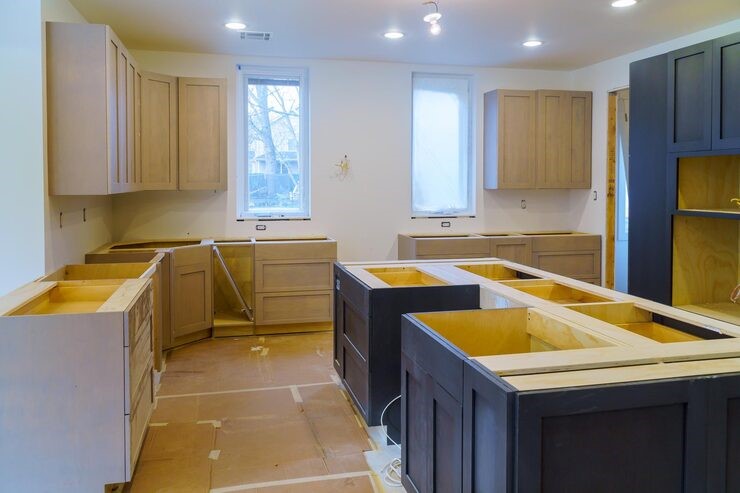
Installing mobile home kitchen cabinets requires a different approach than a standard house. The main mistake homeowners make is ignoring the unique wall structure and weight limits of a manufactured home. Walls in these homes often use thinner studs and different spacing, so standard installation methods can fail.
To get the best result, installers must find the studs exactly and use the right hardware to prevent the cabinets from pulling away. This ensures the kitchen stays safe and looks sharp for years.
Forgetting to Check for Level Floors
Mobile homes can shift over time as they settle. If the floor is not perfectly flat, the cabinets will lean. This makes the doors swing open on their own or causes drawers to stick.
Always use a long level across the floor before starting. Use shims, small wedges of wood, under the base units to make everything perfectly straight.
Using the Wrong Screws
Standard drywall screws are too brittle for this job. They can snap under the weight of heavy plates and mugs. Use specialized cabinet screws with a wide head.
These grip the thin wall studs better and won’t pull through the back of the cabinet box. Safety is a big deal here, so don’t cut corners on the hardware.
Ignoring the Weight Limit
Mobile home walls are usually made of 2×3 or even 1×2 studs instead of the 2x4s found in traditional houses. Hanging heavy, solid oak units can actually warp the wall.
It is vital to choose lightweight but sturdy materials. If the cabinets are too heavy, they might sag or even fall, which is a massive safety risk for the family.
Blocking the Vents
Many mobile homes have heating and cooling vents in the floor or at the bottom of the walls. A common rookie mistake is covering these vents with the new cabinet base.
This kills the airflow in the house and makes the heater work way too hard. Always measure and cut out a space in the cabinet toe-kick to let the air flow freely
Settling for Unfinished Kitchen Cabinets
Many people try to save money by grabbing unfinished kitchen cabinets from Home Depot for their project. While the price looks good at first, these units are often bulky and don’t fit the weird dimensions of a mobile home.
You spend hours sanding and painting them, only to find they don’t line up with your existing plumbing. They also lack the moisture protection needed for a kitchen environment unless you spend a lot more on high-end sealants.
Measuring Only Once
In a mobile home, things are rarely square. The corners might be slightly off, or the ceiling might have a small slope.
If you measure once and order cabinets, you might get a nasty surprise on install day. Measure at the top, middle, and bottom of every wall section. This helps avoid gaps that look cheap and messy.
Overlooking the Plumbing Access
The pipes in a mobile home often come up through the floor rather than through the wall. If the new cabinet doesn’t have the right holes cut out, you can’t hook up the sink.
It is much easier to measure and cut these holes before you move the heavy cabinet into the kitchen. Doing it later usually leads to jagged edges and frustration.
Skipping the Filler Strips
Because walls are often uneven, you will likely have a small gap between the last cabinet and the wall. Don’t just leave it open. Use filler strips, thin pieces of matching wood, to close the gap.
This gives the kitchen a finished, high-end look and prevents crumbs and bugs from falling into the dark spaces behind your units.
Why Custom is the Way to Go
Custom builds solve the problems that mobile home kitchen cabinets usually face. Since mobile homes have specific height and depth needs, custom shops can build units that maximize every inch of space.
You get to choose materials that are light enough for the walls but tough enough for daily use. This prevents the “sagging” look that happens with cheap, heavy store-bought units after just a few years.
Custom vs. Off-the-Shelf Cabinets
The table below shows the core differences between custom-built cabinets and unfinished or stock options.
| Feature | Custom Cabinets | Unfinished/Stock Cabinets |
| Fit | Perfect for mobile home dimensions | Often too deep or wide |
| Material | Lightweight but very strong | Heavy particle board |
| Finish | Professional grade, water-resistant | Requires DIY sanding and painting |
| Longevity | 20+ years | 5-10 years |
| Value | Increases home resale value | Minimal impact on value |
Frequently Asked Questions
Q.1) Can I put regular cabinets in a mobile home?
You can, but it is tricky. Standard cabinets are 24 inches deep, which might block narrow hallways or doorways in a mobile home. They are also much heavier. You must ensure your wall studs can handle the extra load before you hang heavy upper units.
Q.2) How do I find studs in a mobile home wall?
Studs in mobile homes are often 16 or 24 inches apart, but sometimes they are random. Use a high-quality stud finder. If that doesn’t work, look for the tiny nail heads in the wall trim. These usually go straight into a stud.
Q.3) What is the best material for mobile home units?
Plywood is the gold standard. It is lighter than MDF or particle board but holds screws much better. It also handles the vibrations and “flexing” that happens when a mobile home moves or settles, meaning your cabinets won’t crack at the seams.
Q.4) Do I need to remove the old wall paneling first?
Not necessarily. If the paneling is in good shape and flat, you can install cabinets right over it. Just make sure your screws are long enough to go through the cabinet back, the paneling, and deep into the wood stud.
Take the Leap into Custom Design
Installing new cabinets is the best way to refresh a mobile home. Avoiding common mistakes like poor leveling or heavy materials keeps the home safe and beautiful.
While big-box stores offer cheap options, they often cause more stress than they are worth. So, a custom cabinet is a better choice than buying unfinished kitchen cabinets from Home Depot.
For a stress-free upgrade, TeamUP Cabinets Ltd. provides custom solutions that fit mobile homes perfectly. Our experts handle the design and installation to ensure a flawless finish. Give your kitchen the professional touch it deserves.